
- The Science Behind Mental Frequency: Where Psychology Meets Vibration
- 1. You Practice Emotional Granularity
- 2. You Engage in Cognitive Reframing Naturally
- 3. You Maintain Compassionate Boundaries
- 4. You Experience Frequent States of Flow
- 5. You Default to Curiosity Over Judgment
- 6. You Practice Embodied Self-Awareness
- 7. You Cultivate Genuine Gratitude as a Practice
- Why "Raising Your Frequency" Is More Than Spiritual Talk
- Cultivating Your High-Frequency Mind: It's Trainable
- The Ripple Effect: Why Your Frequency Matters Beyond You
- Conclusion: Your Invitation to Higher Functioning
- Frequently Asked Questions
- 1. You Think in Multi-Dimensional Layers
- 2. You Experience Profound Emotional Depth
- 3. You Possess "Flash-Point" Intuition
- 4. You Are Highly Prone to Sensory Overload
- 5. You Have "Supernatural" Pattern Recognition
- 6. You Struggle with "Small Talk" and Crave Intellectual Depth
Have you ever noticed how some people seem to navigate life’s challenges with an almost magnetic calm? They radiate positivity, bounce back from setbacks, and maintain mental clarity even in chaos. Meanwhile, others—perhaps even you on difficult days—feel trapped in cycles of worry, negativity, and emotional exhaustion.
This isn’t about luck or personality type. It’s about your mental frequency.
In psychology, a high-frequency mind isn’t just new-age jargon—it’s a measurable state of emotional regulation, cognitive flexibility, and neurological resilience. While spiritual traditions speak of “raising your vibration,” neuroscience reveals what’s actually happening: optimized brain chemistry, enhanced heart rate variability, and a nervous system that operates from calm rather than chaos. When your mind operates at this elevated state, you experience greater emotional bandwidth, sharper decision-making, and deeper connections with others.
Let’s explore the seven distinct psychological signs that indicate you’re cultivating a high-frequency mind—and why science says this matters more than you think.
The Science Behind Mental Frequency: Where Psychology Meets Vibration
Before we dive into the signs, let’s bridge the gap between metaphysical language and measurable reality.
When we talk about “frequency” in spiritual contexts, we’re often describing emotional states and thought patterns. But psychology gives us concrete frameworks for understanding this phenomenon. Your mental frequency correlates to:
- Neurochemical balance: Optimal levels of serotonin, dopamine, and oxytocin versus stress hormones like cortisol
- Heart rate variability (HRV): Higher HRV indicates greater nervous system flexibility and emotional resilience
- Brainwave patterns: Coherent alpha and theta waves associated with calm focus versus scattered beta waves linked to anxiety
- Parasympathetic activation: Operating from “rest and digest” rather than constant “fight or flight”
A high-frequency mind isn’t about toxic positivity or denying difficult emotions. It’s about having the psychological infrastructure to process challenges without becoming consumed by them. It’s emotional intelligence in action.
Now, let’s examine the seven signs that your mind operates at this elevated state.
1. You Practice Emotional Granularity
The Sign: Instead of simply feeling “bad” or “stressed,” you can identify nuanced emotions like disappointment, frustration, or anticipatory anxiety.
The Psychological Explanation: This ability is called emotional granularity—a cornerstone of emotional intelligence that separates reactive minds from responsive ones. When you possess high emotional granularity, your brain creates more precise emotional categories. This specificity isn’t just semantic; it changes how your brain processes and regulates emotions.
Research in affective neuroscience shows that people with greater emotional granularity experience less intense physiological stress responses. Why? Because precise labeling activates the prefrontal cortex, which helps regulate the amygdala’s alarm signals. You’re literally calming your nervous system through accurate emotional vocabulary.
Real-World Example: After a difficult meeting, instead of spiraling into “I’m terrible at my job,” you recognize: “I feel embarrassed about that one comment, but proud of how I handled the technical questions.” This precision prevents emotional flooding and enables targeted problem-solving.
2. You Engage in Cognitive Reframing Naturally
The Sign: When obstacles arise, you automatically search for alternative perspectives rather than fixating on the worst-case scenario.
The Psychological Explanation: Cognitive reframing is a hallmark of psychological resilience and a key component of cognitive flexibility. High-frequency minds don’t suppress negative thoughts—they actively restructure them. This process engages the dorsolateral prefrontal cortex, which governs executive function and adaptive thinking.
People who naturally reframe challenges show greater activation in brain regions associated with positive emotion regulation. They’re not delusional optimists; they’re cognitive athletes who’ve trained their brains to find workable interpretations of difficult situations.
This aligns with principles from Cognitive Behavioral Therapy (CBT), where challenging automatic negative thoughts reduces anxiety and depression. When you do this habitually, you’re operating from a higher mental frequency—one that sees possibilities rather than dead ends.
Real-World Example: Your project gets rejected. Instead of thinking “I’m a failure,” you automatically wonder: “What feedback can I extract? What would I do differently? Is this actually pointing me toward a better opportunity?” This isn’t denial—it’s adaptive processing.
3. You Maintain Compassionate Boundaries
The Sign: You can say “no” without guilt and “yes” without resentment, honoring both your needs and others’ dignity.
The Psychological Explanation: Boundary-setting reflects high emotional intelligence and secure attachment patterns. A high-frequency mind understands that boundaries aren’t walls—they’re the frameworks that make genuine connection possible.
This behavior indicates a well-regulated nervous system. When you operate from parasympathetic dominance (calm state) rather than sympathetic arousal (threat state), you can assess situations clearly. You’re neither people-pleasing to avoid conflict nor rigidly defensive to protect yourself.
The psychological principle at work is differentiation—maintaining your sense of self while remaining emotionally connected to others. People who achieve this balance report lower anxiety, healthier relationships, and greater life satisfaction.
Real-World Example: A friend asks for a favor during your already-packed week. You respond warmly: “I’d love to help, but I’m at capacity right now. Could we look at next week, or is there someone else who might be available?” No apology spiral, no resentment—just honest, kind clarity.
4. You Experience Frequent States of Flow
The Sign: You regularly lose track of time while engaged in meaningful activities, experiencing effortless concentration and intrinsic motivation.
The Psychological Explanation: Flow states, identified by psychologist Mihaly Csikszentmihalyi, represent peak mental frequency. During flow, your brain operates in a unique neurological state: the prefrontal cortex temporarily downregulates (a phenomenon called transient hypofrontality), reducing self-criticism and time awareness, while dopamine, norepinephrine, and endorphins flood your system.
People who access flow regularly demonstrate superior emotional regulation and life satisfaction. Why? Flow requires the perfect balance between challenge and skill—a balance that high-frequency minds naturally calibrate. They’re neither bored (understimulated) nor anxious (overwhelmed).
This state also promotes neuroplasticity, literally rewiring your brain for greater capacity. Each flow experience strengthens your ability to enter that state again.
Real-World Example: You’re working on a creative project or solving a complex problem, and suddenly three hours have passed. You weren’t forcing concentration—you were absorbed. You emerged feeling energized rather than depleted. This is your high-frequency mind in action.
5. You Default to Curiosity Over Judgment
The Sign: When confronted with unfamiliar ideas, different perspectives, or someone’s mistakes (including your own), your first response is curiosity rather than criticism.
The Psychological Explanation: This orientation reflects cognitive openness and psychological safety—both internally and in relation to others. A judgment-driven mind operates from threat detection, constantly categorizing experiences as good/bad, right/wrong. This activates the amygdala and keeps you in a state of subtle vigilance.
A curiosity-driven mind, conversely, engages the brain’s reward and learning centers. When you approach situations with genuine interest, you activate dopaminergic pathways associated with exploration and discovery. This creates a positive feedback loop: curiosity generates learning, learning builds competence, and competence reduces anxiety.
This mindset also correlates with what psychologists call a “growth mindset”—the belief that abilities and understanding can develop through effort. People with growth mindsets show greater resilience, creativity, and mental well-being.
Real-World Example: Someone shares a political view you disagree with. Instead of immediate defensiveness or mental counterarguments, you think: “That’s interesting. I wonder what experiences led them to that conclusion? What might I be missing?” This doesn’t mean abandoning your values—it means approaching differences with psychological flexibility.
6. You Practice Embodied Self-Awareness
The Sign: You notice physical sensations—tension in your shoulders, tightness in your chest, energy levels—and use these as information about your emotional state.
The Psychological Explanation: This is interoception—your brain’s ability to sense and interpret internal bodily signals. High interoceptive accuracy is strongly linked to emotional intelligence and mental health.
Your body and brain aren’t separate systems; they’re in constant communication through the vagus nerve and other pathways. A high-frequency mind recognizes that anxiety often appears as shallow breathing before conscious worry, that excitement and nervousness share physiological signatures, and that fatigue might signal emotional overwhelm rather than just physical tiredness.
This body-mind integration allows for earlier intervention. When you catch stress in your shoulders, you can address it before it escalates into a full anxiety spiral. This embodied awareness also enhances decision-making—research shows that people who tune into bodily signals make better choices, particularly in complex situations.
Real-World Example: During a stressful day, you notice your jaw clenching and shoulders creeping toward your ears. Instead of pushing through, you recognize: “My body is signaling stress overload.” You take three deep breaths, stretch, or step outside—not as procrastination, but as strategic nervous system regulation.
7. You Cultivate Genuine Gratitude as a Practice
The Sign: You regularly acknowledge specific things you appreciate, not as forced positivity but as genuine recognition of what’s working in your life.
The Psychological Explanation: Gratitude isn’t just a nice sentiment—it’s a neurologically transformative practice. Consistent gratitude practice increases gray matter in the prefrontal cortex and enhances activity in brain regions associated with dopamine production.
From a psychological frequency perspective, gratitude shifts your brain’s default scanning mode. Most brains evolved with a negativity bias—constantly scanning for threats and problems. This kept our ancestors alive but leaves modern humans chronically focused on what’s wrong.
Deliberate gratitude practice retrains your reticular activating system (the brain’s filter for relevant information) to notice positive data without ignoring real challenges. This isn’t about denying difficulties; it’s about achieving perceptual balance. People who maintain gratitude practices show measurably lower cortisol levels, better sleep quality, and greater psychological resilience.
Real-World Example: Before bed, you mentally note three specific things: “The way my colleague defended my idea in the meeting. The texture of that perfectly ripe peach at lunch. Making my daughter laugh at dinner.” Not Instagram-worthy moments—just real, noticed experiences. This simple practice literally rewires your brain toward higher frequency.
Why “Raising Your Frequency” Is More Than Spiritual Talk
The language of “high vibration” and “frequency” often gets dismissed as pseudoscience, but there’s a reason these metaphors resonate: they describe real psychological and physiological states.
When spiritual teachers talk about “raising your vibration,” psychologists see:
- Emotional regulation: Managing feelings without suppression or explosion
- Cognitive flexibility: Adapting thinking patterns to match reality
- Nervous system coherence: Operating from calm rather than constant threat
- Positive affect: Experiencing a broader range of positive emotions
- Social connection: Building secure, reciprocal relationships
These aren’t woo-woo concepts—they’re measurable markers of mental health and well-being.
The heart’s electromagnetic field, for instance, is detectable several feet from the body and changes based on emotional state. Heart Rate Variability—the variation in time between heartbeats—serves as a biomarker for nervous system flexibility. Higher HRV correlates with better emotional regulation, decision-making, and stress resilience.
Similarly, coherent brainwave patterns (when different brain regions synchronize) occur during states of calm focus, meditation, and flow. These states feel like “higher frequency” because they literally involve more organized, efficient neural communication.
The bridge between science and spirituality isn’t about proving one right and the other wrong—it’s recognizing they’re describing the same phenomena using different languages.
Cultivating Your High-Frequency Mind: It’s Trainable
Here’s the empowering truth: these seven signs aren’t fixed personality traits. They’re skills.
Neuroplasticity—your brain’s ability to reorganize and form new neural connections—means you can deliberately cultivate a high-frequency mind through:
- Mindfulness practices that enhance emotional granularity and interoception
- Cognitive behavioral techniques that strengthen reframing abilities
- Boundary-setting exercises that honor your emotional bandwidth
- Flow-inducing activities that match challenge with skill
- Gratitude journaling that rewires your perceptual filters
- Curiosity cultivation through active listening and perspective-taking
- Somatic practices like breathwork or yoga that integrate body-mind awareness
Each practice strengthens specific neural pathways, gradually shifting your default mental frequency from reactive to responsive, from scattered to coherent, from survival mode to thriving mode.
The Ripple Effect: Why Your Frequency Matters Beyond You
Operating from a high-frequency mind doesn’t just improve your individual experience—it influences everyone around you.
Mirror neurons in our brains cause us to unconsciously mimic the emotional states of people we interact with. When you maintain emotional regulation during conflict, others’ nervous systems often follow. When you practice curiosity over judgment, you create psychological safety that allows others to be authentic.
This isn’t about perfection or constant positivity. It’s about developing the internal resources to navigate life’s inevitable challenges with grace, clarity, and resilience.
Your mental frequency is contagious. Choose wisely what you transmit.
Conclusion: Your Invitation to Higher Functioning
Recognizing these seven signs in yourself isn’t about ego or superiority—it’s about awareness. A high-frequency mind represents optimal psychological functioning: emotional intelligence, cognitive flexibility, and nervous system resilience working in harmony.
If you identified with these signs, celebrate that. If you didn’t, know that every single characteristic is developable with practice and patience.
The journey toward a high-frequency mind is the journey toward becoming more fully yourself—calm amidst chaos, compassionate without losing boundaries, and connected to the richness of your own experience.
Ready to deepen your emotional intelligence and mental well-being? Explore more science-backed insights on mindset, psychological resilience, and the neuroscience of everyday life at Sentimentshub.com. Your high-frequency mind awaits.
Frequently Asked Questions
Q: Can you train your brain to operate at a higher frequency?
A: Absolutely. Thanks to neuroplasticity, your brain continuously reorganizes based on experience and practice. Consistent mindfulness, cognitive reframing exercises, gratitude practices, and embodied awareness activities physically change brain structure and function over time. Research shows measurable changes in gray matter density and neural connectivity within 8-12 weeks of regular practice.
Q: Is having a high-frequency mind the same as being constantly positive?
A: No. A high-frequency mind isn’t about forced positivity or denying negative emotions. It’s about emotional range and regulation—experiencing the full spectrum of feelings while maintaining the psychological flexibility to process them without becoming overwhelmed. It includes the capacity to feel sadness, anger, or fear while still returning to baseline rather than staying stuck in reactive patterns.
Q: How does emotional granularity differ from just being sensitive?
A: Emotional granularity is about precision in identifying emotions, not intensity in feeling them. Someone might be highly sensitive (experiencing emotions strongly) but low in granularity (only knowing they feel “bad”). Granularity provides specific vocabulary—distinguishing disappointment from resentment, nervousness from excitement. This precision activates different brain regions and enables more targeted emotional regulation, transforming sensitivity from overwhelm into insight.
Do you ever feel like your brain is running on a completely different bandwidth than the people around you? Perhaps you find yourself processing the world with an intensity that is both exhilarating and exhausting—feeling overwhelmed by the hum of a refrigerator one moment, then experiencing a flash of brilliant, complex insight the next. If you have always felt “different,” intuitive, or intellectually rapid, you aren’t just imagining it. You may possess what is known as a high-frequency mind.
While the term “vibrations” is often used in spiritual contexts, neuroscience provides a concrete foundation for this experience through the study of Gamma brainwaves (30-100 Hz). These are the fastest brainwaves produced by the human brain and are a primary indicator of peak focus, rapid information processing, and high-level cognitive synthesis. Having a high-frequency mind means your neural architecture is wired for “multi-dimensional thinking,” allowing you to process layers of information simultaneously. While this is a profound gift, it often leads to high-processing sensitivity and overstimulation.
Here is what psychology and neuroscience say about the 7 signs you are operating at a higher mental frequency.
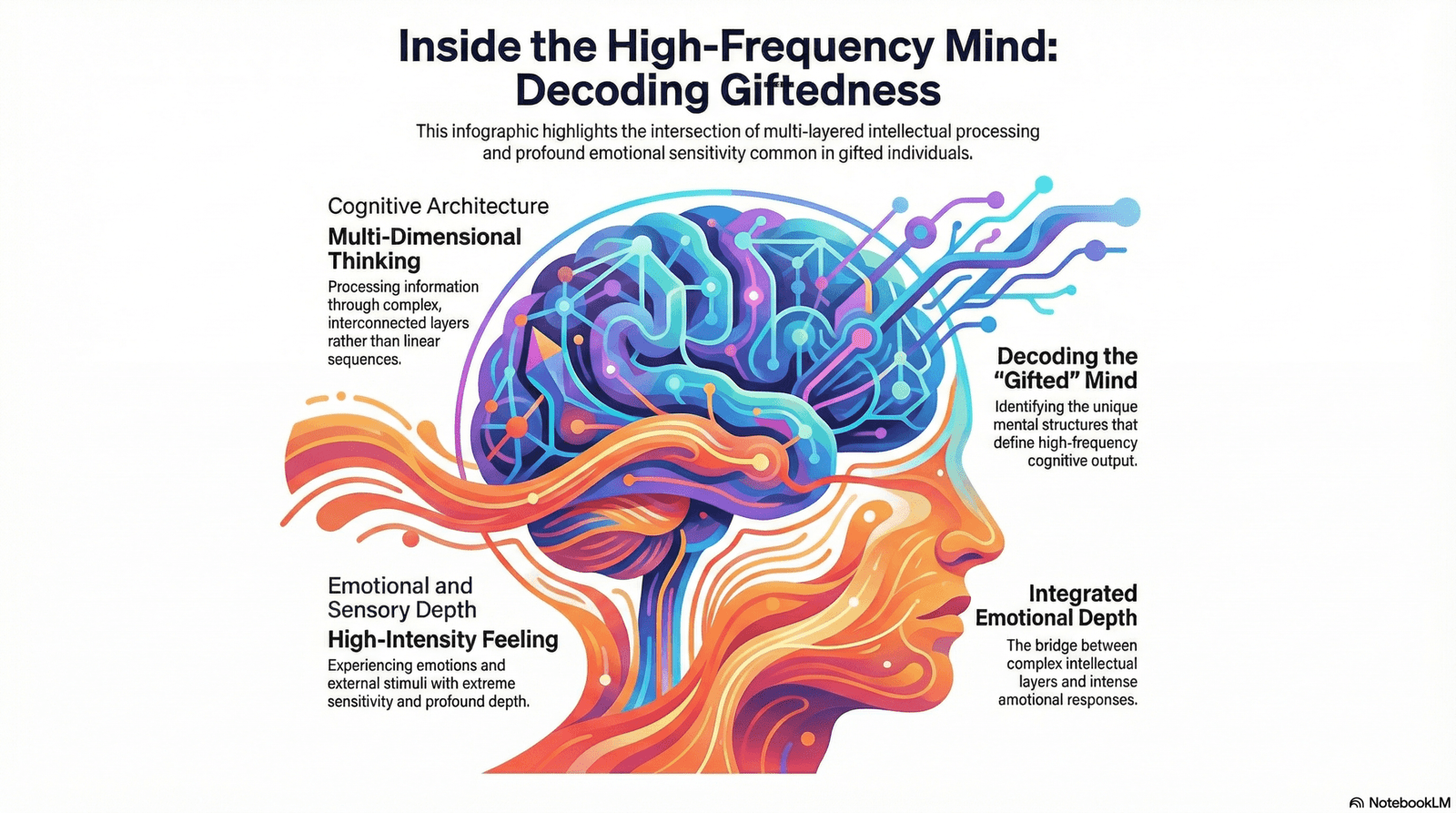
1. You Think in Multi-Dimensional Layers
One of the most prominent signs of high intelligence psychology identifies is the ability to move beyond linear thought. If you have a high-frequency mind, you likely engage in “multi-dimensional thinking,” where you don’t just see a problem; you see its history, its potential future, and its connection to seemingly unrelated concepts all at once. This thinking in layers allows you to decode complex systems and “gifted” patterns that others might overlook. You aren’t just processing facts; you are synthesizing a web of interconnected data points at a high velocity.
2. You Experience Profound Emotional Depth
For those with a high-frequency mental state, the world isn’t just seen—it is felt. A core component of this architecture is “emotional depth,” where you feel everything with an unusual intensity. This is closely linked to highly sensitive person (HSP) traits, where the brain’s mirror neuron system and sensory processing hubs are highly active. You may experience “high vibration signs” of intense joy or empathy that feel almost electric. This isn’t “being overly sensitive”; it is a byproduct of a brain that is tuned to pick up on the subtlest emotional frequencies in any given environment.
3. You Possess “Flash-Point” Intuition
Psychological research into Gamma brainwaves symptoms often highlights the “Aha!” moment—that sudden flash of insight where a solution appears out of nowhere. This is a key psychological sign of intuition linked to high-frequency processing. Because your brain is synthesizing information across multiple regions at 30-100 Hz, you often reach conclusions before you can even explain the logical steps taken to get there. This rapid-fire intuition is a hallmark of a mind that is constantly scanning and integrating data at a subconscious level.
4. You Are Highly Prone to Sensory Overload
Because a high-frequency mind is constantly engaged in rapid information processing, your “filter” for external stimuli can often become thin. Psychology refers to this as High Sensory Processing Sensitivity (SPS). While others can easily tune out background chatter, bright fluorescent lights, or the scent of a coworker’s perfume, your brain is busy “decoding” these inputs in real-time. This is one of the more challenging highly sensitive person (HSP) traits; because you process information more deeply and feel everything with such intensity, you often reach a threshold of overstimulation faster than those around you.
5. You Have “Supernatural” Pattern Recognition
Do you often spot trends, anomalies, or shifts in a room’s energy before anyone else does? This is a hallmark of a mind that naturally thinks in layers. From a neurological standpoint, this is one of the primary Gamma brainwaves symptoms. When your brain operates at a higher frequency (30-100 Hz), it facilitates the “binding” of different sensory inputs into a singular, coherent concept. This allows “gifted” individuals to see the hidden architecture behind social dynamics, complex data sets, or artistic structures that others simply miss. This ability to recognize patterns is a key sign of high intelligence psychology recognizes as a marker of high-level cognitive synthesis.
6. You Struggle with “Small Talk” and Crave Intellectual Depth
For someone operating at a high mental frequency, superficial interactions can feel physically and mentally draining. This is because your cognitive architecture is built for multi-dimensional thinking and emotional depth. You aren’t being “difficult” or “snobbish”; your brain simply requires a high level of “data-rich” input to feel engaged. You likely find yourself drawn to complex, existential, or abstract topics because they provide the necessary “fuel” for your rapid mental processing. This “high vibration sign” is actually your nervous system seeking a level of complexity that matches its own internal frequency.
7. You Are Driven by a Need for Constant Mental “Flow” and Hyper-Curiosity
A high-frequency mind is rarely at rest. Because your brain is optimized for rapid information processing, you likely find yourself in a perpetual state of “hyper-curiosity.” You don’t just want to know what happened; you want to know why and how it connects to the broader world. This drive often leads to “flow states,” where Gamma brainwaves symptoms—such as heightened awareness and peak concentration—are most prevalent. In these moments, your sense of time vanishes as you become fully immersed in a complex task. Psychology identifies this capacity for deep immersion as one of the significant signs of high intelligence psychology researchers often associate with the “gifted” brain. Your mind requires a constant stream of high-quality “data” to stay balanced; without it, you may feel restless, bored, or under-stimulated.
Conclusion: Embracing the Architecture of Your High-Frequency Mind
Living with a high-frequency mind is a complex journey of balancing extraordinary cognitive gifts with intense sensory and emotional sensitivities. As we have explored, the unique “architecture” of your mind is specifically designed for multi-dimensional thinking and emotional depth, allowing you to decode the world’s complexities in ways that others might overlook.
While the modern world can occasionally feel too loud, too fast, or too shallow for your nervous system, it is important to remember that your high-processing sensitivity is not a flaw—it is a sophisticated neural trait. By understanding the psychological signs of intuition and the role that Gamma brainwaves play in your daily experience, you can begin to navigate your life with more intention and self-compassion.
If you recognize these high vibration signs in yourself, know that you aren’t “too much” or “broken.” You are simply operating on a higher bandwidth. Embracing your ability to think in layers and feel everything intensely is the first step toward mastering your mental frequency and sharing your unique perspective with a world that needs it.

A storyteller and emotional architect, dedicated to capturing the essence of human experience through words. My journey began with a deep fascination for language, evolving into a unique voice that resonates on a personal level. With an intuitive grasp of complex emotions, I craft messages that speak directly to the soul. Every word I write reflects my commitment to quality, as I believe the right words can truly transform lives.


